Monksblade in Cormyr
Monksblade is a small hamlet in eastern Cormyr, strategically situated on the Way of the Manticore, east of the Wyvernflow crossing at Wheloon. Today it serves as a favored overnight stop for merchants traveling between Cormyr and Sembia, but the village’s name recalls a far more dramatic past.
The present settlement is built almost entirely from the crumbling ruins of four ancient monasteries that once stood here. In earlier days Monksblade was home to holy houses dedicated to:
- Chauntea, the Lady of Grain
- Tempus, Lord of Battles
- Tyche, ancient goddess of fortune (later replaced by Tymora and Beshaba)
- Umberlee, the Stormgoddess and Queen of the Deeps
These four religious communities once flourished together, shaping the surrounding countryside and defending the region from monsters and raiders.
The Monasteries of Old Monksblade
Mother Chauntea’s House and the Watchers Over the Land
The monastery devoted to Chauntea was known as Mother Chauntea’s House, and it housed an unusual militant religious order called the Watchers Over the Land.
Other religious orders mockingly called them “strawheads,” but their beliefs were practical and uncompromising. The Watchers believed humankind could not survive in the savage northern lands without:
- Abundant and well-managed farms
- Good roads connecting those farms to markets
- Well-defended villages and ports
- Wtrong laws protecting trade and agriculture
From their monastery they worked tirelessly to establish and enforce such laws.
Their militant efforts focused largely on maintaining road patrols. These patrols proved vital in clearing monsters from the coastal lands of eastern Cormyr, where creatures had once been so numerous that they could raid farms almost at will.
Despite their successes, the warrior-priests of Chauntea suffered grievous losses during these campaigns.
The Red Knights of Tempus
As word of the Watchers’ struggles spread, a patriarch of Tempus in the Vilhon Reach reported that Tempus himself deemed the situation in Cormyr worthy of aid.
Soon afterward the Red Knights of Tempus arrived in strength.
These warriors rode out from a fortress called the Towers of War, located at the eastern end of what is now the hamlet of Monksblade. The Red Knights made war upon the monsters plaguing the region and steadily cleared ever larger areas of wilderness, allowing the Watchers to extend their patrols and maintain order.
The ruins of the Towers of War still stand today and now house the well-known Firedagger Inn.
The Lucky Knights of Tyche
The success of these religious warriors attracted a wave of settlers from Sembia and the Vilhon Reach. Many of these newcomers brought with them the worship of Tyche, Lady of Fortune.
The Followers of Fortune constructed a fortified abbey known as Lady’s House, built at the center of the monastic complex.
From this abbey rode the famous Lucky Knights, champions of Tyche who traveled far and wide across the lands surrounding the Sea of Fallen Stars.
Clad in shining armor, these knights errant became renowned for both heroic deeds and romantic adventures. Their exploits and courtly wooings helped give Cormyr its enduring reputation for gallantry and romance throughout the Inner Sea lands.
Although the Lucky Knights disappeared roughly three hundred winters ago, their legend still shines brightly in stories told across the region.
The Worshipers of the Wave
The followers of Umberlee were known as the Worshipers of the Wave. They lived in a vast manor complex called the House of the Seas, which was built beside and partially around Lady’s House.
This sprawling structure possessed countless wings and towers that seemed to stretch for miles. Many of the houses standing in Monksblade today were built directly from these ruins.
Because the original buildings were connected as a single complex, modern houses in the hamlet often appear joined together, with stables and covered sheds stretching almost to touch neighboring buildings.
The priests and followers of Umberlee devoted themselves to protecting sailors and fishermen from the dangers of the sea. They performed offerings to their goddess to keep coastal waters safe.
Using magic that allowed them to breathe beneath the sea, they ventured into the depths twice each year to capture sea monsters for sacrifice in Umberlee’s honor.
During the rest of the year they crewed small, swift boats, hunting pirates relentlessly in the name of the Queen of the Deeps.
The Fall of the Monastic Community
For a long time the four religious houses existed in a state of unusual cooperation, and the surrounding lands prospered under their combined protection.
However, the wealth and influence of the monasteries also attracted constant attacks from:
- Brigands
- Lizardfolk from the Vast Swamp
- Agents and opportunists from Sembia
Over the centuries these persistent raids slowly weakened the monasteries until they were eventually abandoned.
For a time the empty buildings became strongholds for brigands who effectively ruled the region.
Finally the Crown of Cormyr intervened. The king lacked the funds to construct a new fortress in the area and had grown weary of bandits establishing their own rule in the deserted monasteries.
Instead, he sponsored settlers to occupy the ruins and rebuild the community. With limited military and logistical support from the Crown, these pioneers established the hamlet that survives today.
The modern inhabitants of Monksblade proudly trace their heritage back to those Crown-sponsored settlers.
Landmarks
The Ruined Monastery Gardens
Although Monksblade has diminished somewhat as other coastal settlements grew larger, the hamlet remains a delightful place to behold.
Huge ancient trees shade overgrown gardens, cemeteries, and scattered ruins. Cottages stand among the remains of the old monasteries, creating a landscape where past and present blend together.
Lost Knights’ Dance
The monasteries were founded here originally because of a deep well of pure, fresh water, located in the gardens of Mother Chauntea’s House.
The well remains there today and is still regarded as holy by followers of Chauntea.
In the final days of the monasteries, several unscrupulous mages attempted to plunder the monks’ wealth. They were confronted by the last remaining Knights of Tempus and Tyche, who fought side by side to defend the holy houses.
Six of these defenders died beside the well. They were struck down by arrows while trapped in Otto’s Irresistible Dance spells, forced to helplessly shuffle about while their enemies slaughtered them.
The site has since been known as Lost Knights’ Dance.
On certain moonlit nights the shadowy, armored spirits of these knights appear in the gardens, silently dancing as they did in their final moments.
Local legend claims that these spirits sometimes reveal secret entrances into the monastery ruins or the locations of hidden treasure to those who bear the holy symbols of Tempus or Tyche.
Hidden Treasures and Dark Rumors
Approximately 300 people now live in Monksblade, and some have surely followed the directions given by the spectral knights.
Most easily accessible treasure has long since been recovered. Nevertheless, rumors persist that deep underground cellars beneath the monasteries remain unopened.
Some claim these hidden chambers contain a temple of an evil cult that may still survive.
There are also many stories of holy swords once wielded by the knights of Tempus and Tyche. According to legend, dying warriors hid these blades within the monasteries before crawling back to die in the consecrated courtyards.
The teachings of Tempus specifically name Monksblade as a place where sacred weapons still lie hidden, awaiting champions worthy to wield them.
Life in Monksblade
To most visitors passing through Monksblade, the hamlet’s dramatic past is little more than a pleasant collection of stories told by the fire at the Firedagger Inn. Travelers often spend their evening there with a mug of mulled cider and a plate of the inn’s famous hot buttered mushrooms.
Thea, one of the inn’s serving maids, claims the mushrooms are gathered from the ruins that surround the village. The preparation is simple but delicious. The caps are placed into a covered pan of melted butter along with salt, a pinch of basil, and a small dash of firefruit or lemon juice. They are fried until they release their own rich brown broth and then served piping hot. The stalks are never wasted; they are simmered in chicken stock to flavor the soups served the following morning. It is humble fare, yet many visitors insist it tastes fit for the gods.
In addition to the welcoming Firedagger Inn, Monksblade offers several other establishments of note. The tavern Hunting the Knight is widely praised for its relaxed atmosphere and lively storytelling. The restaurant The Old Oyster is regarded as one of the finest dining houses in all of Cormyr. The hamlet also contains a swap-horse stable and a tack and ironmongery shop, both reliable if otherwise unremarkable. More curious travelers will also find Wendeira’s Wondery, a shop whose unusual wares make it well worth a visit.
Places of Interest in Monksblade
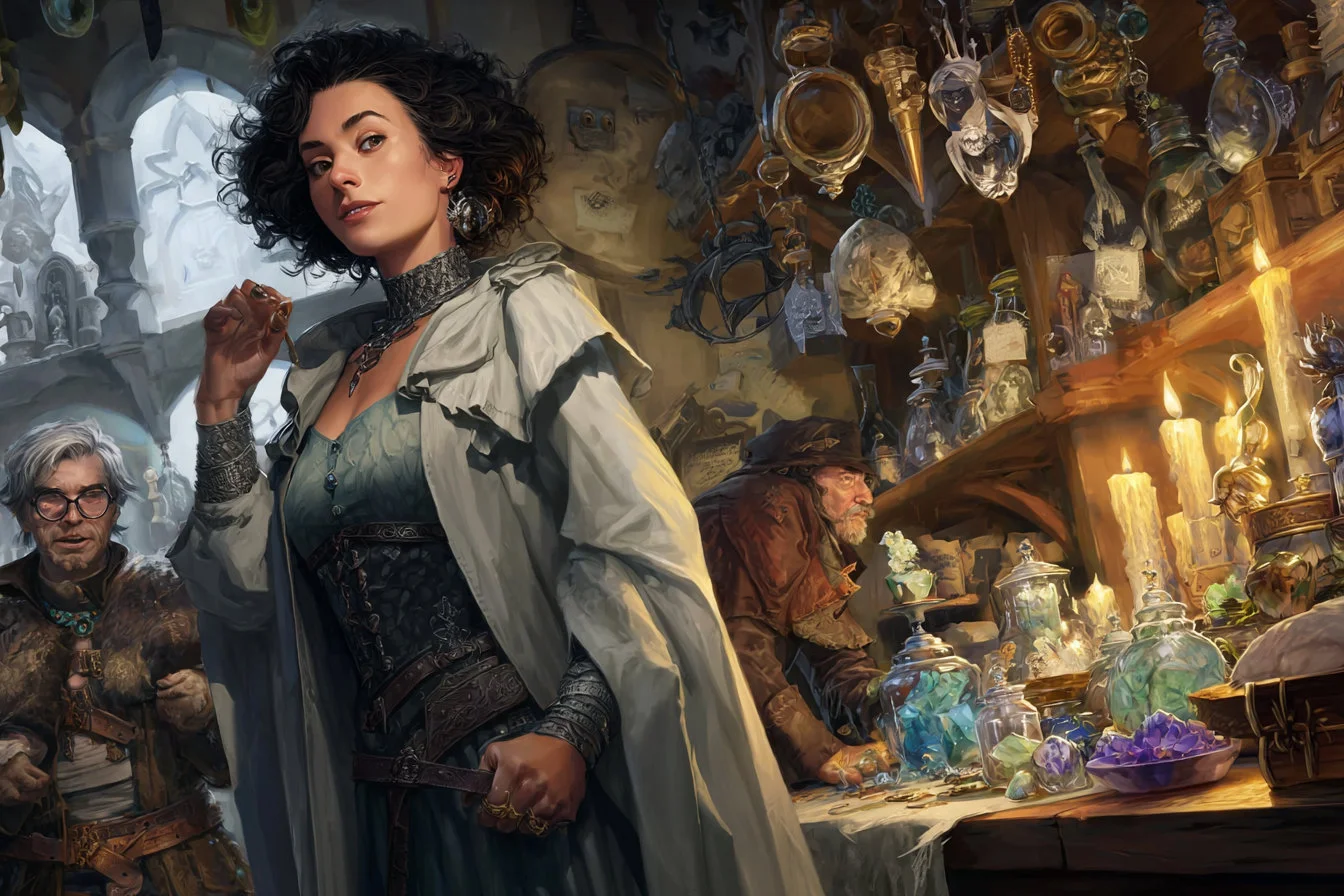
Wendeira’s Wondery
Oddments and Minor Magical Items
Wendeira’s Wondery is a strange, cavernlike shop crammed from floor to ceiling with a chaotic collection of oddments, curiosities, and minor magical items. Many of the objects within carry small enchantments. Visitors may find kindling canisters that keep their contents perfectly dry, wardrobes that stand upright and open their doors at a spoken command, or rings that glow briefly when twisted.
The shop’s proprietor, Wendeira, is as unusual as her merchandise. She is a lithe and strikingly beautiful woman whose dark eyes appear startlingly large within her pale, bone-white face. She drifts constantly through the shop, singing softly while dusting her wares and caressing them fondly as she moves. Her clothing is always dark, and the styles she favors vanished from the courts of the Inner Sea generations ago.
Some customers whisper that she may not be entirely alive and choose not to linger. Those who stay discover a remarkable collection of wonders. Wendeira acquires many of her stranger goods from her friend Aurora, the famed merchant whose catalog establishments are spreading across Faerûn.
Among the curiosities offered for sale are glass fishbowls shaped like life-sized voluptuous women, chairs whose brass hands can be adjusted to hold pipes, books, or lamps, and mirrors that sing a full cycle of songs whenever they are uncovered. The shop also carries a line of glow-in-the-dark domino masks, a fashionable accessory currently popular in Sembia, Westgate, and even distant Waterdeep.
These masks vary widely in size and color, some shining with softly shifting radiances. Prices range from about two hundred and fifty gold pieces for the simplest designs to nearly three thousand for the most elaborate creations. One particularly rare mask even grants its wearer the ability to fly briefly once every tenday, a trick that has reportedly made it popular with lovers seeking discreet midnight visits to high balconies.
Restaurants
The Old Oyster
The Old Oyster is one of Monksblade’s most charming establishments. The building consists of two crumbling stone turrets connected by a long, low kitchen. The dining room’s windows—clear glass of remarkable quality—look south over the tangled gardens that once belonged to Lady’s House. On quiet evenings diners can watch foxes wandering through the ruins while fireflies drift lazily in the fading light.
As the name suggests, oysters are a specialty here. These are brought upriver from the fishing village of Moonever, located at the mouth of the Wyvernflow. Freshwater eels are also commonly served, a delicacy beloved by many coastal Cormyreans—though some travelers remain less enthusiastic.
The restaurant maintains an excellent cellar of ales and wines. Visitors are often warned about the local fern-and-mint wine, which is famously cold and sharp. Its flavor is so intense that many claim it overwhelms the taste of anything consumed afterward for the rest of the evening.
More familiar dishes can also be found on the menu, including stewed hare, roasted pork or beef, and grilled pheasant. However, the dish that truly sets the Old Oyster apart is wyvern tail.
True wyvern tail was once far easier to obtain when the Stonelands teemed with those creatures. The genuine meat is firm and white, somewhat reminiscent of the finest pork. Because such meat is now rarely available, most cooks imitate the dish using a carefully seasoned mixture of pork, turkey, and rabbit known as Jack’s Wyvern Tail.
At the Old Oyster this imitation is called Old Wyvern Tail, and the recipe includes chopped roasted almonds and asparagus broth. The mixture is wrapped in crisp pork crackling sewn into a thick arc shaped like a section of a wyvern’s tail and served atop mushroom-creamed fried potato coins. The portions are enormous—large enough to feed four hungry travelers or provide two diners with two full meals and a generous portion of cold leftovers the following day.
Taverns
Hunting the Knight
Hunting the Knight is a welcoming and comfortable tavern made up of low-beamed rooms, dark booths, and flagstone-floored chambers. Each room contains its own fireplace and a stone chest stocked with cool wine. The entire establishment is furnished with deep chairs and couches that encourage patrons to settle in and spend the evening talking.
Food is scattered generously throughout the tavern. Wheels of salty cheese, bowls of nuts, and—when in season—boiled peapods and fiddleheads can be found everywhere, freely available to guests.
Many of the tavern’s regular patrons are elderly farmers or retired adventurers who delight in sharing stories of Monksblade’s past. Among the most famous of these tales is the story of the Looking Lady.
This ghostly figure is said to appear only when sea mists roll inland across the hamlet. Witnesses describe her as a tall woman in flowing gowns who glides silently through the monastery gardens, searching desperately for something. From time to time she startles villagers by thrusting her skull-like face suddenly through a window before withdrawing again.
According to local legend, the Looking Lady seeks a small statuette that holds her soul. It is said to be part of a hidden treasure hoard left behind by an evil wizard who once enslaved her. If the treasure is ever discovered, the story goes, the spirit will attach itself to the finder and follow them forever as a guardian watch-ghost.
Inns
The Firedagger Inn
The Firedagger Inn stands among the ruins of the old Towers of War. Its name comes from a spectacular magical incident that occurred during a duel between Artigaun of Tyraturos, a Red Wizard, and Ondelos the Archmage of Selgaunt.
During the battle, a magical blade known as a firedagger was unleashed. Both wizards died in the duel, leaving the weapon spinning in midair where Ondelos had last cast it. The blade continued to whirl and spit flame until a summoned war wizard managed to banish it.
Even now the firedagger occasionally reappears in the inn’s dining hall and must be banished again. Powerful enchantments prevent anyone from removing or controlling it. Attempts to do so cause the blade to blink erratically about the room while spraying jets of fire.
Despite this unusual hazard, the inn itself is a delightful place to stay. It is a sprawling building filled with luxuriously furnished, wood-paneled rooms. Each suite contains its own bathing chamber and dressing room, and the thick walls ensure that guests rarely hear one another at night.
Meals are delivered through locked serving hatches in covered warming platters. The dishes are simple but perfectly prepared, and there is never any shortage of juices, teas, or hot broths. Guests may summon these refreshments at any hour by pulling the appropriate bell cord.
The inn’s staff are quiet and discreet, yet surprisingly attentive. They happily provide storytelling for frightened children, massages for weary travelers, or companions for games of cards. Two lively chambermaids—Areele and Baeranthra Morlar—even serve as fencing partners for guests who wish to practice their swordplay.
The Firedagger Inn also contains a charming walled garden where couples may stroll in privacy during the evening. Its stable is capable not only of housing horses but also repairing carts and tending to injured animals. These additional services add 10 gold pieces to a guest’s bill.
All in all, the Firedagger is considered one of the finest inns in the region—and a perfect place for travelers to spend a comfortable and perhaps romantic evening in Monksblade.


